Showing posts with label Borneo. Show all posts

Monday, January 24, 2022

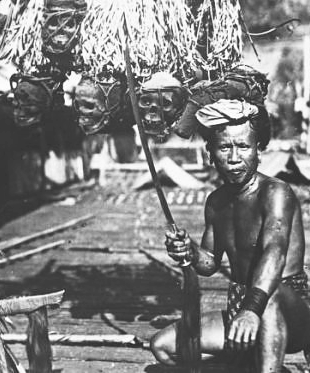
Headhunting tradition of Dayak tribes

Dayak is a term for natives of the island of Borneo. They are a tribe of people living in Kalimantan especially in Central Kalimantan. Dayak, divided into 405 sub-sub clans. Each sub-Dayak both Indonesia and Malaysia are identical. Dayak customs and culture comes from the word "Power" which means upstream, to refer to people who live in inland areas or in the interior of Borneo. In the arsenal of art and culture, Dayak has many similarities such as; saber, chopsticks, beliong, betang, cupai, renjung, empajang and others.

Warfare, including headhunting, slave capture, plunder and conquest, was practiced by Dayaks in various parts of Borneo until early part of the 20th century.

Until now there are still some Dayak tribal customs are still preserved. Dayak supernatural world in ancient times still looked strong until now. This custom is one of the cultural property owned by the Indonesian nation. A long time ago the famous Dayak with the term "ngayau" (adventuring by finding the opponent's head to become "Dengah").

Headhunting played a central role in the social organization, religion, and worldview of nearly all Dayak groups of Borneo. Headhunting among the tribe is believed to have begun when the land inhabited by the Ibans grew into over-population and confrontation was an inevitable requirement for survival.

Headhunting, derived from the word "me and ngayau". Me means action, ngayau: beheading enemies, decapitating enemy action (Mengayau contained in the Iban language and Ibanik, also on the Dayak community in general).

Successful headhunters enhanced their own prestige, in part because their actions were perceived to contributes to the prosperity of kin and community through the performance of certain important rituals.

These rituals, such as the Iban kenyalang and the Kenyah mamat, required fresh human heads for their performance.

Headhunting has been associated with ideas regarding the head as the seat of the soul, with some forms of cannibalism in which the body or part of the body is consumed in order to transfer to the eater the soul matter of the victim, and with phallic cults and fertility rites intended to imbue the soil with productivity.

A few groups decorated their trophy skulls in characteristic ways by either attaching wooden or other elements to individual skulls and/or by engraving mostly floral elements on the neurocranial and facial parts of the trophy.

Dayaks are very careful to defend their females, hence in their system of head-taking, the heads of females are more highly valued than those of the men, in as much as it requires more artifice and bravery to obtain them.
Headhunting tradition of Dayak tribes
Monday, November 4, 2019

Dayak tribe of Borneo

The indigenous peoples of the Heart of Borneo are commonly known as Dayak. The term ‘Dayak’ refers collectively to non Muslim or non Malay natives of Borneo in general. The term ‘Dayak’ appeared at the end of the nineteenth century, in the context of the imposition of Dutch colonial rule over the tribes residing in the interior regions of Borneo.

Ethnic Dayak consists of six major ethnic groups and divided into 405 sub small tribe, who live spread across the hinterlands of Borneo including Sabah and Sarawak Malaysia. The Dayak who carved numerous works of art descend from the original inhabitants of Borneo who arrived on there around 35.000 years ago.

Dayak traditions in daily life are farming. Dayak traditions of farming life that have changed-moving from one place to the other, looking for fertile land to grow crops.

Traditional tattooing has been customary among men and women in several groups of Dayak Peoples. They use motif designs of snakes, birds and plants, sometimes combined, to symbolise meanings such as bravery, patience and beauty. The motifs are symbolic of the social class, and of individuals of a certain social standing that are allowed to be tattooed with particular motifs.

Most of the Dayak people still adhere to the belief of the existence of unseen objects in certain places such as rocks, large trees, planting gardens in the forest, lakes, pools, and others are believed to have "magical powers".
Dayak tribe of Borneo

Friday, April 1, 2016

Kelabit tribe in Sarawak

The life of a Kelabit community is a perennial balancing act between the longhouse and its surrounding fields on the one hand and the forest just beyond on the other. Both are important and both are expressed through food.

With the population of approximately 3000, the Kelabit form a tight-knit community and practice a generations-old form of agriculture. They are farmers who use buffalo and sophisticated methods of irrigation.

Famous for their rice-farming, they also cultivate a variety of other crops which are suited to the cooler climate of the Highlands. Bario rice is renowned for its delicate flavor.

The Kelabit are also known for their great strength and for their cultures so building megaliths, such as dolmens in honour of ancestors.

Before the Second World War, the people of the Kelabit Highlands were scattered over the area. Since then, most of the population has become concentrated in an area now called Bario in the northern part of the highlands, where the only government-run airstrip is situated.
Kelabit tribe in Sarawak

Saturday, April 27, 2013

Headhunting practices in Borneo

Headhunting can be defined as an organized, coherent form of violence in which the severed head is given a specific ritual meaning and the act of head taking is consecrated and commemorated in some form.

It was a common practice among the indigenous tribes of Borneo until the decades of the 20th century. Headhunting practices were a predominant factor in the tropical life of Borneo during pre-colonial times as well as a means of securing fertility for human beings and for the lands.

Warfare among the tribes group was common, and it was considered a sign of strength for a young man to seek out and cut off a rival warriors head.

The freshly collected heads would be skinned and dried smoked over a fire or boiled and then hung up for all to see in the longhouse.

To take a head was a sign of virility and the more heads that a longhouse possessed, the greater its prestige and it was hoped its prosperity.
Headhunting practices in Borneo

The most popular articles